Super Clone vs Replica Watch: What Is the Difference?
Introduction
If you have searched for replica watches online, you have probably seen terms like super clone, 1:1 replica, high quality replica, and standard replica. Sellers often use these names to describe different levels of quality, but the meaning behind them is not always clear.
Some sellers claim that super clone watches look almost identical to authentic luxury watches. Others use the same term to promote products with different materials, movements, and levels of finishing.
So, what is the actual difference between a super clone vs replica watch? Is a super clone always better, or is it simply another marketing term?
In this guide, we will explain the difference in simple English. We will cover appearance, movements, materials, timekeeping, durability, pricing, and the important details to consider when comparing these products.
What Is a Replica Watch?
A replica watch is a watch made to copy the appearance or design of another watch. It may have a similar case shape, dial layout, bracelet, bezel, or colour scheme.
Replica watches come in different quality levels. Some use basic materials and inexpensive movements, while others have more detailed finishing and better components.
For example, a replica inspired by the Rolex Submariner may have a black dial, a rotating bezel, and a metal bracelet similar to the original design. However, the materials, movement, construction, and performance may be very different.
The term replica does not tell you exactly how well a watch is made. You need to examine its specifications and construction to understand what you are getting.
It is also important to know that a watch carrying another company’s trademark without authorization is not an authentic watch, regardless of its quality.
What Is a Super Clone Watch?
A super clone watch is a term used in the replica watch market to describe an imitation that is marketed as a higher quality version of a branded watch.
These watches are often promoted for their detailed finishing, similar case proportions, and movements designed to reproduce some of the functions found in the original model.
For example, a seller may describe a Submariner style watch as a super clone because it has a detailed dial, a polished case, and an automatic movement.
However, there is no universal industry standard that defines a super clone. One seller may use the term differently from another.
The name alone does not prove that a watch uses premium materials, keeps accurate time, or offers long term reliability.
When comparing super clone watches, always look at the actual specifications instead of relying only on the product title.
Super Clone vs Replica Watch: Main Differences
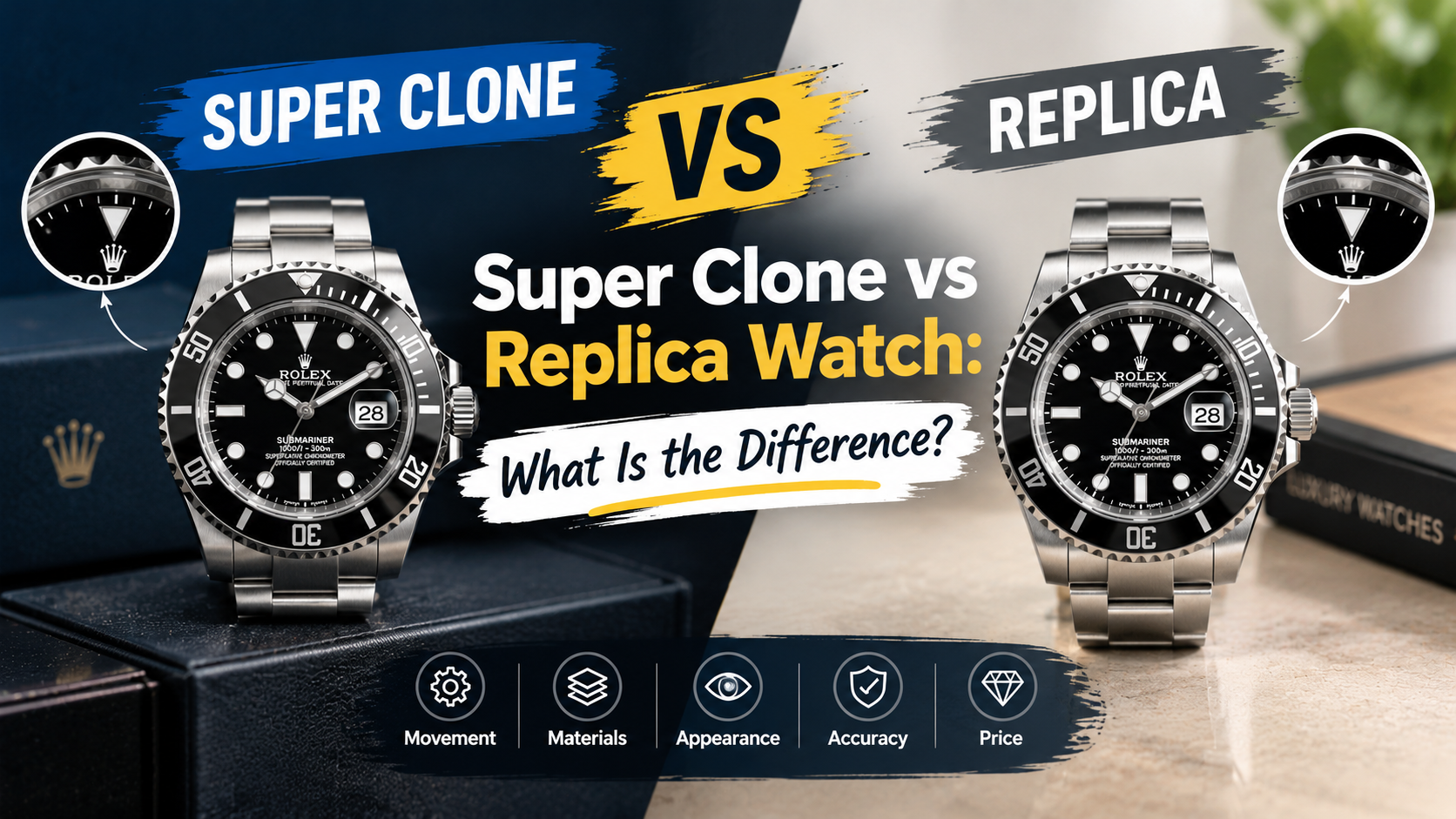
The main difference is how these watches are described and marketed. A standard replica is often presented as a basic imitation, while a super clone is promoted as a more detailed version.
Here is a simple comparison.
| Feature | Standard Replica Watch | Super Clone Watch |
| Appearance | May have visible differences from the original | Marketed as having closer visual details |
| Dial finishing | Quality varies by product | Often promoted for more detailed finishing |
| Case and bracelet | Materials and construction vary | Often marketed with improved finishing |
| Movement | May use quartz or automatic movements | May use a movement marketed as a closer match |
| Timekeeping | Depends on the movement and condition | Depends on the movement and condition |
| Durability | Depends on construction and maintenance | Depends on construction and maintenance |
| Price | Often marketed at a lower price | Often marketed at a higher price |
| Authenticity | Not an authentic branded watch | Not an authentic branded watch |
These are general market descriptions, not guaranteed differences. A watch marketed as a super clone can still have poor finishing or an unreliable movement. A standard replica may also be well made in certain areas.
The actual product matters more than the name used to sell it.
1. Appearance and Design
Appearance is one of the main reasons people compare super clone and replica watches.
Buyers often look at the dial, hands, hour markers, bezel, case shape, bracelet, and overall proportions.
A watch may look convincing in a product photograph but show noticeable differences when examined closely. Uneven markers, poor printing, misaligned parts, and rough finishing can affect its appearance.
For example, when comparing two watches inspired by the Rolex Datejust, you might examine the dial colour, date window, bezel shape, and bracelet links.
A higher price does not automatically mean that a watch has more accurate details. Promotional photographs can also hide small differences.
If appearance is important to you, look for clear photographs of the actual product rather than relying only on stock images or advertising claims.
2. Watch Movements
The movement is the mechanism that powers a watch. It is one of the most important parts to consider when comparing replica watch quality.
There are three common movement types.
Quartz movement: A battery powers the movement. Quartz watches generally offer good timekeeping and are easy to maintain.
Automatic movement: A mechanical mechanism winds through wrist movement. Many automatic watches can also be wound manually.
Manual winding movement: The wearer winds the watch by turning the crown.
Some replica watches use inexpensive movements, while others are marketed with more complex mechanisms. However, the term super clone does not guarantee that the movement is identical to the one used in the original watch.
When researching replica watch movements, look for the movement manufacturer, model, available specifications, and servicing options.
If the seller cannot provide reliable details, be careful about claims regarding movement quality or performance.
3. Materials and Finishing
Materials affect how a watch looks, feels, and performs over time.
The case, bracelet, crystal, bezel, and clasp should be considered separately. Two watches may look similar in photographs but use different materials and construction methods.
For example, the quality of the steel, surface brushing, polishing, and bracelet links can affect the overall appearance and feel.
The crystal is another important component. Depending on the product, it may use mineral glass, synthetic sapphire, or another material. These materials have different properties, including scratch resistance.
Do not assume a watch uses sapphire crystal or a particular grade of steel simply because the seller calls it a super clone.
Ask for clear product specifications when these details matter to you.
4. Accuracy and Timekeeping
A watch can look excellent and still perform poorly.
Timekeeping depends on several factors, including the movement, adjustment, condition, and maintenance. Two watches with similar designs can produce very different results.
Quartz movements generally provide consistent timekeeping. Mechanical and automatic movements can also perform well, but their accuracy depends on the movement and its condition.
A watchmaker can use a timegrapher to measure certain aspects of a mechanical movement. However, one test does not guarantee long term reliability.
Be cautious when sellers claim that a super clone watch offers the same accuracy as an authentic luxury watch without providing supporting evidence.
5. Durability and Water Resistance
Durability is another area where buyers should look beyond marketing terms.
A watch’s lifespan depends on its construction, movement, assembly, exposure to moisture, impacts, and maintenance.
Water resistance requires particular attention. A seller may describe a replica watch as waterproof or suitable for swimming, but these claims should not be accepted without proper testing and reliable documentation.
A water resistance rating is useful only when it is supported by appropriate testing. An untested watch should not be assumed safe for swimming or showering.
If you are considering a watch for daily wear, check whether servicing and replacement parts are available before making a purchase.
6. Why Do Super Clone Watches Cost More?
Super clone watches are often sold at higher prices because sellers claim to offer better finishing, more detailed designs, or more advanced movements.
These features can affect manufacturing costs, but a higher price does not automatically confirm better quality.
The price may also include marketing, seller margins, packaging, and other costs that do not directly improve the watch.
Before comparing prices, review the product specifications, movement information, warranty terms, return policy, and servicing options.
A clear description of the product is more useful than a seller simply calling it premium or the best available.
7. How to Compare Two Replica Watches
If you are comparing two watches with similar designs, use the same checklist for both.
Check the specifications. Review the stated movement, materials, dimensions, and functions.
Examine the photographs. Look closely at the dial, hands, markers, bezel, case finishing, and bracelet.
Review movement details. Find out whether the movement information is documented and whether servicing is available.
Check the warranty. Understand what happens if the watch stops working or develops a fault.
Research the seller. Look for independent customer feedback and clear return and repair policies.
Question unsupported claims. Terms such as super clone, 1:1, premium, and top quality do not have consistent technical definitions.
This approach helps you make a more informed comparison based on the available evidence.
8. Are Super Clone Watches the Same as Authentic Luxury Watches?
No. A super clone watch is not the same as an authentic luxury watch.
Even if a product is marketed as having similar visual details or mechanical functions, that does not establish that it was made by the original manufacturer or meets the same production standards.
Authentic watches may come with manufacturer documentation, authorized servicing, and a traceable product history. These benefits may not be available with unauthorized imitations.
Watches that use another company’s trademark without permission can also raise legal issues, depending on the product and the country involved.
If authenticity, warranty support, resale value, and long term ownership are important to you, buying an authentic watch from a reputable source is the safer option.
9. Common Myths About Super Clone Watches
Myth 1: Every super clone is better than a standard replica
Not necessarily. Super clone is a marketing term, and quality varies between products. Actual specifications and reliable evidence matter more.
Myth 2: A super clone uses the same movement as the original
This is not guaranteed. A movement may reproduce certain functions without being identical to the movement used in the original watch.
Myth 3: A higher price always means better quality
Not always. Price can reflect marketing and seller margins as well as manufacturing costs. Compare the actual product details before drawing conclusions.
Myth 4: Every super clone is water resistant
No. Water resistance should not be assumed without appropriate testing and reliable documentation.
Myth 5: A super clone has the same resale value as an authentic watch
An imitation does not gain the authenticity or resale value of the original simply because it looks similar. Be cautious about claims of equal resale value.
Frequently Asked Questions
What is the difference between a super clone and a replica watch?
A super clone is generally marketed as a more detailed or higher quality imitation, while a standard replica may be presented as a basic version. There is no universal standard for these labels, so the actual quality depends on the individual product.
Are super clone watches worth the higher price?
That depends on the product’s construction, documented specifications, reliability, and available support. A higher price does not guarantee better quality.
Do super clone watches use automatic movements?
Some do, while others use different movement types. Always check the exact product specifications instead of assuming every super clone has an automatic movement.
Are super clone watches authentic?
No. The term describes an imitation product in this context. A watch does not become authentic because it looks similar to a branded model or carries a particular marketing label.
What does 1:1 replica mean?
The phrase 1:1 replica is used to suggest that a product closely matches the original in appearance or dimensions. However, it does not guarantee identical materials, construction, movement, or quality.
Can you tell the difference between a super clone and an authentic watch?
Sometimes differences are visible in the dial, finishing, dimensions, or other details. Other differences may require professional examination. A visual comparison alone cannot always establish authenticity.
What should you check before buying a watch?
Review the materials, movement information, construction, warranty, return policy, and availability of repairs. Do not rely on product names or marketing claims alone.
Final Thoughts
The main difference between a super clone vs replica watch is how the product is marketed and the level of quality the seller claims to offer. Super clone watches are generally promoted as more detailed imitations, but the label does not guarantee better materials, accurate timekeeping, or long term reliability.
The best way to compare watches is to examine their actual specifications, construction, movement, and available support. Clear product information is more useful than claims such as 1:1, premium, or super clone.
If authenticity, warranty coverage, and long term value are your priorities, an authentic watch from a reputable source remains the better choice.